

chemical clean, repairing surface cracks, and applying a professional-grade resurfacer or decorative sealant. These methods address unsightly discoloration and scaling, providing a durable finish that mimics the appearance of newly poured concrete for a fraction of the cost.
Assessing the Slab: Restoration vs. Replacement
Before embarking on a restoration journey, a thorough assessment of your driveway’s structural integrity is necessary. Not every driveway is a candidate for a surface-level makeover. Most concrete surfaces suffer from superficial issues, such as small pits, oil stains, or sun-faded patches, which do not compromise the home’s actual foundation. If your driveway is generally level but looks tired, restoration is the most efficient route for homeowners seeking concrete driveway repair in Murfreesboro, TN.
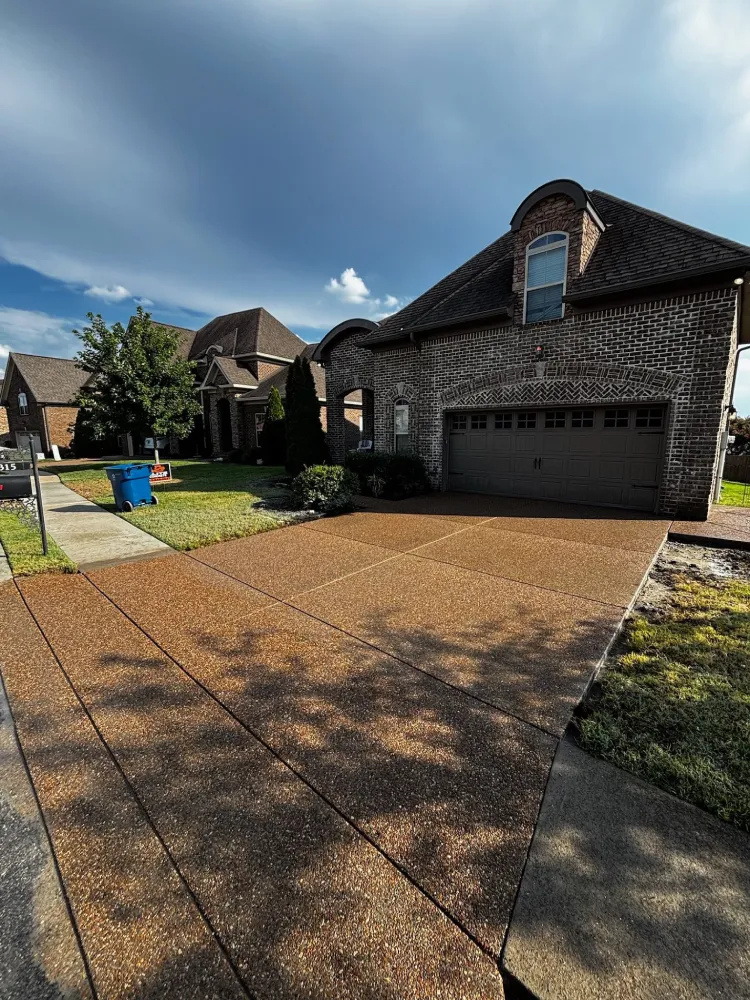
However, if you notice large, deep craters, slabs that have sunk several inches, or cracks wider than half an inch running deep into the soil, the sub-base may have failed. In these cases, adding a new layer is like putting a bandage on a broken bone. During a recent project evaluation in a quiet neighborhood nearby, we observed that many homeowners mistake surface aesthetic wear for total failure. Most of these slabs just needed a professional touch to regain their curb appeal. As a family-owned business, we prioritize honesty in these assessments, ensuring you don’t spend on a full replacement when a restoration will suffice.
Deep Cleaning and Pore Preparation
The foundation of any restoration is a clinical level of cleanliness. Over the decades, concrete acts like a hard sponge, soaking up automotive fluids, tannins from fallen leaves, dirt, and microscopic organic growth. These contaminants live deep within the pores. To make the surface look new, you must strip away these layers using a combination of high-pressure water and heavy-duty degreasers.
While working on a driveway repair in Murfreesboro, TN, recently, we noticed that skipping the degreasing phase is the primary cause of premature peeling in many projects. If oil remains in the pores, the new resurfacer or sealer will simply float on top rather than bonding. Proper preparation ensures that the new wear layer integrates with the old concrete. This step is non-negotiable if you want the finish to withstand heavy vehicle traffic and the friction of turning tires over the coming years.
Repairing Cracks and Spalling
Cracks are the most visible signs of age and the most likely entry point for further damage. When water enters a crack and freezes, it expands, pushing the concrete apart and turning a small hairline fracture into a major gap. Filling them correctly involves widening the crack slightly with a chisel to create a “V”-shaped opening. This might seem counterintuitive, but it allows the repair material to seat deeply and bond to the vertical sidewalls of the slab.
We recently completed a series of concrete driveway repairs in Murfreesboro for a client in a historic neighborhood, to preserve the original layout while erasing decades of weathering. Using a high-strength polymer-modified filler, we ensured the patch could flex slightly with the earth’s natural expansion and contraction. Meticulously leveling the filler flush with the existing slab ensures that once the final coating is applied, the repair becomes completely invisible. This prevents water from seeping into the sub-base, the root cause of slab shifting.
The Art of Concrete Resurfacing
If your driveway has widespread pitting or a “sandpaper” texture known as spalling, a simple cleaning won’t be enough to restore its youth. This is where resurfacing becomes the best option. A resurfacer is a specialized blend of Portland cement, fine sands, and polymer modifiers. Unlike standard concrete, it can be applied in a very thin layer, sometimes as thin as 1/16 inch, without cracking or delaminating.
This process provides a “reset button” for your driveway’s appearance. It masks all previous patches and repairs, providing a consistent color and texture across the entire entry. You can choose different finishes during this stage, from a smooth troweled look to a broom finish that provides extra traction during rainy weather. Because it bonds molecularly to the old concrete, it effectively becomes part of the original slab, adding years to the surface’s life.
Advanced Protection and Sealants
Once the repairs are cured and the resurfacer has set, the final step is protection. Think of a sealer as the “skin” of your driveway. Unsealed concrete is vulnerable to salt, chemicals, and UV rays that break down the binders in the cement. A high-quality sealer prevents these elements from penetrating the driveway, making it much easier to clean in the future.
The technology used to protect these high-end finishes has evolved significantly. Just as a luxury vehicle owner might apply an advanced protective treatment to shield paint from oxidation and environmental fallout, a professional concrete driveway repair in Murfreesboro, TN, provides a hydrophobic barrier for your home. This protective layer ensures that the new surface remains resistant to stains and UV damage for the long term. Moisture will bead up and roll off rather than soak in, making it the best defense against the freeze-thaw cycles that plague older driveways.
The Elite Surface Revival System
While the steps for restoration may seem like a weekend DIY project, the reality is that concrete is a temperamental material. The window of time to work with resurfacers is incredibly short, often influenced by temperature and humidity. As a family-owned business, Elite Concrete focuses on delivering results that stand the test of time through precise material mixing and application.
Choosing a professional approach ensures the surface profile is correct for maximum adhesion. We use industrial-grade grinders and specialized cleaning agents that aren’t available at standard hardware stores. We handle the heavy lifting of grinding and cleaning, allowing you to enjoy a transformed exterior without the labor-intensive trial and error. Our team treats every driveway as if it were our own, ensuring the final texture is both slip-resistant and visually striking, providing a safe surface for your family and guests.
Long-Term Maintenance Strategies
A restored driveway is an investment that requires minimal but consistent care to stay looking new. You should aim to sweep away loose dirt and debris weekly, as decaying organic matter can eventually stain the sealer if left on it. Additionally, rinsing the driveway with a garden hose once a month can prevent the buildup of fine dust that dulls the finish.
Every three to five years, it is wise to have a professional inspect the sealer. Depending on traffic volume and sun exposure, a simple “refresh” coat of sealer can extend the life of your resurfacing indefinitely. This proactive approach is a tiny fraction of the cost of a full replacement and ensures your home’s curb appeal never fades.
Choose Car Restoration Today!
You do not have to endure the mess, noise, and high expense of a full demolition to have a beautiful home entrance. By following a structured process of deep cleaning, structural repair, and professional resurfacing, you can achieve a stunning transformation that lasts. Restoration is the smart, durable choice for those looking to boost curb appeal and protect their investment.
For those who want the job done right with expert precision and the personal touch of a local team, Elite Concrete is ready to assist. We pride ourselves on transforming tired slabs into the envy of the street.
Contact us to learn more about our restoration options and how we can make your driveway look brand new again.
People Also Ask
Is it cheaper to resurface or replace a concrete driveway?
Resurfacing is significantly more cost-effective. It eliminates the costs of heavy machinery, demolition labor, debris disposal, and the high volume of new concrete required for a full pour. Most homeowners save thousands by choosing restoration.
How long does a concrete resurfacing last?
When applied to a stable base and maintained with a high-quality sealer, a resurfaced driveway can last 10 to 15 years. Regular resealing every few years can further extend this lifespan.
Can I resurface a driveway with large cracks?
If cracks are wider than a quarter-inch or the slabs are unlevel, it may indicate sub-base failure or significant ground shifting. A professional inspection is recommended to determine if the ground is stable enough for a surface-level fix or if structural stabilization is needed first.
How soon can I drive on a restored driveway?
While you can typically walk on the surface within 24 hours of the final coat, it is best to wait at least 72 hours before driving a vehicle on it. This allows the polymers to reach their full load-bearing strength and ensures the sealer has completely cured.