

High-ceiling covered patios can help smoke disperse by providing more vertical space for warm air and smoke to rise before reaching the roof. However, ceiling height alone does not eliminate smoke problems. Patio openings, roof design, wind direction, appliance placement, and ventilation also affect how smoke moves.
Why Does Smoke Rise Under A Covered Patio?
Smoke from a fire pit or grill rises because combustion produces heat, making the surrounding air warmer and less dense. The rising warm air carries smoke and combustion particles upward.
A covered patio changes this natural movement because the roof eventually stops the upward path. Once smoke reaches the underside of the roof, it can spread laterally or move toward open sides.
A higher ceiling provides more vertical space between the heat source and roof. This can give warm air and smoke additional room to rise, spread, and cool before reaching the overhead structure.
For homeowners considering Covered Patios in La Vergne, TN, this is an important consideration when planning an outdoor area around a grill or fire feature.
How Does Ceiling Height Affect Smoke Dispersion?
Ceiling height changes the amount of air available above a grill or fire pit.
A low ceiling places the roof closer to the smoke source, allowing smoke to reach the overhead surface more quickly. A higher ceiling provides greater vertical distance before smoke reaches the roof.
| Patio Design | Potential Smoke Behavior |
| Low ceiling | Smoke reaches the roof more quickly |
| Moderate ceiling | More room for smoke to rise and spread |
| High ceiling | Greater vertical space before smoke reaches the roof |
| Open-sided high ceiling | More opportunities for smoke to move outward |
These are general airflow principles, not guarantees. Wind and patio configuration can significantly affect actual smoke movement.
What Patio Features Help Smoke Move Away?
Ceiling height is only one part of effective patio design.
Open Sides
Open sides allow fresh air to enter and smoke to move away from the occupied area.
Roof Configuration
The roof shape can influence how smoke travels after reaching the overhead surface. Open perimeters can provide additional escape paths.
Patio Orientation
The patio’s direction relative to typical wind patterns can affect whether smoke moves toward or away from seating areas.
Appliance Placement
The location of a grill or fire pit matters. Positioning a smoke-producing appliance beneath a low or obstructed roof section can restrict airflow.
Cross-Ventilation
Openings on multiple sides can create natural airflow through the patio and provide more opportunities for smoke to escape.
How Should a Covered Patio Be Planned Around a Grill?
Plan the grill area during the initial patio design.
- Choose the Cooking Area: Allow comfortable movement between the grill, seating, and home.
- Check Ceiling Clearance: Maintain appropriate space between the grill and roof.
- Plan Openings: Provide pathways for air and smoke to escape.
- Consider Wind: Position seating away from common smoke paths when possible.
- Account for Heat: Consider clearances, heat-resistant materials, and installation requirements.
- Confirm the Layout: Have a professional evaluate the structure, dimensions, materials, and intended use.
Does A High Ceiling Eliminate Smoke Under A Covered Patio?
No. A high ceiling provides additional vertical space but does not guarantee that smoke will leave the patio.
Smoke can still accumulate when a patio has limited openings, unfavorable wind conditions, or a roof configuration that restricts airflow.
For example, a homeowner in Lake Forest Estates may want a covered patio for entertaining while also planning a permanent grill. The structure and grill should be planned together so the finished space provides appropriate airflow.
What Is The Difference Between Smoke Dispersion And Ventilation?
Smoke dispersion is how smoke spreads through surrounding air and becomes less concentrated.
Ventilation is the movement and replacement of air through openings or other systems.
A high-ceiling patio can provide more space for smoke to disperse, but ventilation depends on how air actually moves through the structure.
An open-sided patio generally provides more opportunities for natural air exchange than a structure with multiple enclosed walls.
Covered Patio And Smoke Terms
Covered Patio: An outdoor living area with an overhead structure that provides shade or weather protection.
Thermal Plume: The upward movement of warm air produced by a heat source such as a grill or fire.
Smoke Dispersion: The process of smoke spreading through surrounding air.
Ventilation: The movement of air into and out of a space.
Cross-Ventilation: Air movement created by openings on different sides of a structure.
Ceiling Clearance: The vertical distance between a heat source and the underside of the overhead structure.
How Does A Covered Patio Roof Affect Smoke?
A roof interrupts the natural upward movement of smoke. After reaching the underside, smoke may move sideways along the ceiling until it encounters an opening.
A roof with an open perimeter can provide more opportunities for smoke to escape. Walls or enclosed sections can restrict that movement.
Elite Concrete describes its covered patios in La Vergne as customized around the home’s layout and intended use, making roof configuration and patio orientation important parts of the overall design.
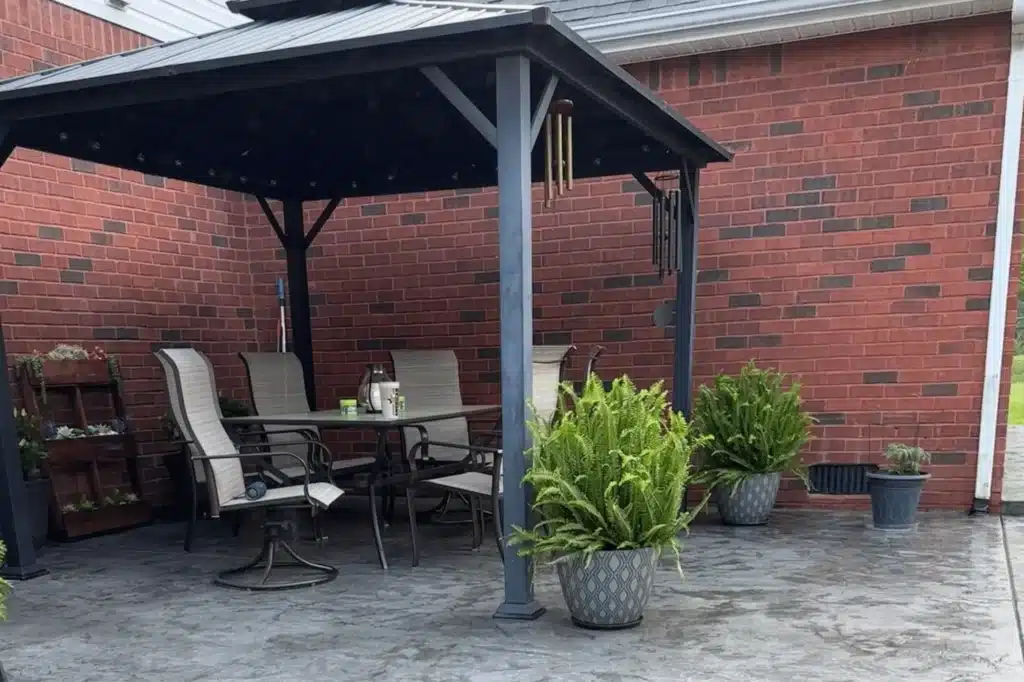
Can A Covered Patio Still Be Comfortable For Grilling?
Yes, provided the design accounts for smoke, heat, airflow, and required clearances.
A covered patio can offer shade and weather protection while supporting outdoor cooking when the grill location and structure are properly planned. Manufacturer installation requirements should always be followed.
Elite Concrete’s covered-patio services are designed for outdoor dining, entertaining, and other outdoor-living uses.
A Common Myth: A Taller Roof Makes A Patio Smoke-Proof
A taller roof does not make a patio smoke-proof.
Additional ceiling height gives smoke more room to rise, but the smoke still needs a pathway out of the structure. If airflow is restricted, smoke can remain beneath the roof regardless of ceiling height.
The better approach combines appropriate ceiling clearance with open sides, thoughtful appliance placement, roof design, and consideration of wind.
This is particularly relevant when planning La Vergne, TN Covered Patios around both cooking and entertaining.
How Should Fire Pits Be Positioned Under A Covered Patio?
Fire pits require careful planning because they produce heat and combustion products.
Before placing a fire pit beneath a covered structure:
- Check the manufacturer’s installation requirements.
- Confirm required overhead clearance.
- Verify that the fire pit is approved for covered use.
- Evaluate nearby combustible materials.
- Consider smoke movement.
- Review applicable local requirements.
- Have the final layout professionally evaluated when appropriate.
Not every fire pit is suitable for operation beneath every covered patio.
How Does Wind Affect Smoke Under A Covered Patio?
Wind can significantly change smoke behavior.
A light breeze may move smoke toward one side, while stronger wind can push smoke through an opening or create turbulence around walls and roof edges.
Because wind direction changes, patio design should provide multiple opportunities for smoke and warm air to leave the occupied area rather than relying on one assumed airflow path.
What Should You Consider Before Building A Covered Patio?
Consider how the patio will be used before construction begins.
- Outdoor cooking: Decide whether the space will include a grill, smoker, or other appliance.
- Fire features: Confirm whether the planned fire feature is compatible with the roof design.
- Seating: Keep primary seating away from likely smoke paths.
- Weather: Balance roof coverage with desired airflow.
- Drainage: Plan the patio surface and surrounding area for appropriate water drainage.
- Structural design: Ensure the foundation, slab, and overhead structure meet applicable requirements.
Design The Patio Around Airflow And Use
High-ceiling covered patios can help manage smoke by providing greater vertical space between a grill or fire source and the roof. However, ceiling height is only one factor.
Open sides, roof configuration, wind direction, appliance placement, ventilation, clearances, and intended use all influence smoke movement.
Elite Concrete provides covered patio and concrete patio services designed around property layout and outdoor-living needs. If you’re planning an outdoor space for grilling, entertaining, or relaxing, contact us today to discuss your patio layout, foundation, covered design, and intended use.
People Also Ask
Does a higher patio ceiling reduce smoke?
A higher ceiling provides more vertical space for warm air and smoke to rise before reaching the roof. It does not eliminate smoke and works best with adequate openings and airflow.
Can you put a grill under a covered patio?
A grill may be used under certain covered structures when permitted by the manufacturer and when required clearances, ventilation, and safety requirements are met.
Can a fire pit be used under a covered patio?
It depends on the fire pit and structure. Some fire pits are not approved for covered use, while others have specific clearance requirements. Always follow manufacturer instructions.
What is the best patio design for smoke from a grill?
A design with adequate ceiling clearance, open sides, natural airflow, and appropriate grill placement can help move smoke away from occupied areas.