
To find patio installers who understand your specific backyard layout, prioritize contractors that offer comprehensive site analysis and custom 3D renderings. Look for professionals who emphasize drainage solutions and topographical mapping to ensure the structure complements your land’s natural contours. By focusing on design-build firms rather than general laborers, you ensure your outdoor space is engineered for both beauty and structural integrity.
Why Your Backyard Layout Requires More Than a Standard Search
Most homeowners begin their journey by typing a simple phrase into a search engine. However, finding someone who truly grasps the nuances of your property goes beyond a basic proximity search. Every backyard has a unique “fingerprint” defined by its slope, soil composition, and existing architectural lines.
When you are looking for patio installers in Murfreesboro, TN, you are likely dealing with specific regional soil conditions and weather patterns that dictate how a foundation must be laid. A contractor who doesn’t take the time to walk the perimeter of your property and discuss how you move from your kitchen to your lawn is simply selling you a product, not a solution. Understanding the layout means recognizing how sun exposure changes throughout the day and how rainwater migrates across the surface during a heavy downpour.
Comparing Specialist vs. General Installers
Choosing the right professional requires a clear understanding of what each tier of contractors provides. Use the following comparison to see how a layout-focused specialist differs from a high-volume installer.
| Feature | Layout-Focused Specialists | General Paving Contractors |
| Initial Assessment | Laser-leveled topographical mapping and soil check. | Visual estimation and basic tape measurements. |
| Design Phase | Custom 3D renderings showing the patio in your yard. | Standard templates or hand-drawn sketches. |
| Drainage Strategy | Integrated systems like French drains or strategic grading. | Basic pitching of the stone away from the house. |
| Structural Integrity | Deep-base compaction tailored to your soil type. | Standard depth regardless of ground conditions. |
| Flow & Function | Traffic pattern analysis for furniture and walking. | Focuses solely on the square footage of the slab. |
5 Steps to Vetting for Spatial Intelligence
If you want a patio that feels like a natural extension of your home, you must vet your candidates for “spatial intelligence.” During a recent audit of a local neighborhood project, we found that many homeowners skip these crucial steps, resulting in “floating” patios that appear disconnected from the house. Many Murfreesboro, TN patio installers can lay stone, but few can integrate it into a complex slope.
- Request a Detailed Grading Plan: Ask the installer exactly where the water will go. A professional who understands your layout will be able to explain the “pitch” and any necessary retaining walls required to keep your yard functional.
- Evaluate Their Visual Communication: Does the contractor provide a 3D model? Seeing the patio situated in your actual backyard layout before the first stone is laid is the only way to ensure the scale and proportions are correct.
- Check for Transition Expertise: A layout expert focuses on the “in-between” spaces. Ask how they will manage the transition from your back door to the patio, and from the patio to the grass.
- Inquire About Site Access: Understanding your layout includes the logistics of construction. A skilled pro identifies how to get equipment in and out without destroying your existing landscaping or underground utilities.
- Verify Experience with Similar Terrains: If your yard is on a steep incline, ask for portfolio photos of similar slopes. Experience with flat lots does not translate to expertise with hillside installations.
Debunking the Flat Ground Myth
A common industry myth is that a perfectly flat backyard is the “ideal” canvas for a patio. In reality, a truly flat surface is a recipe for disaster. Experienced Murfreesboro patio installers know that if a surface is perfectly level, water has nowhere to go, leading to pooling, mold, and eventual structural failure of the stone or pavers.
The truth is that every quality patio must be engineered with a slight, almost invisible slope. This ensures that during the heavy rains common in our region, water is directed safely away from your home’s foundation. If a contractor tells you they don’t need to worry about grading because your yard “looks flat,” they are ignoring the fundamental physics of outdoor construction.
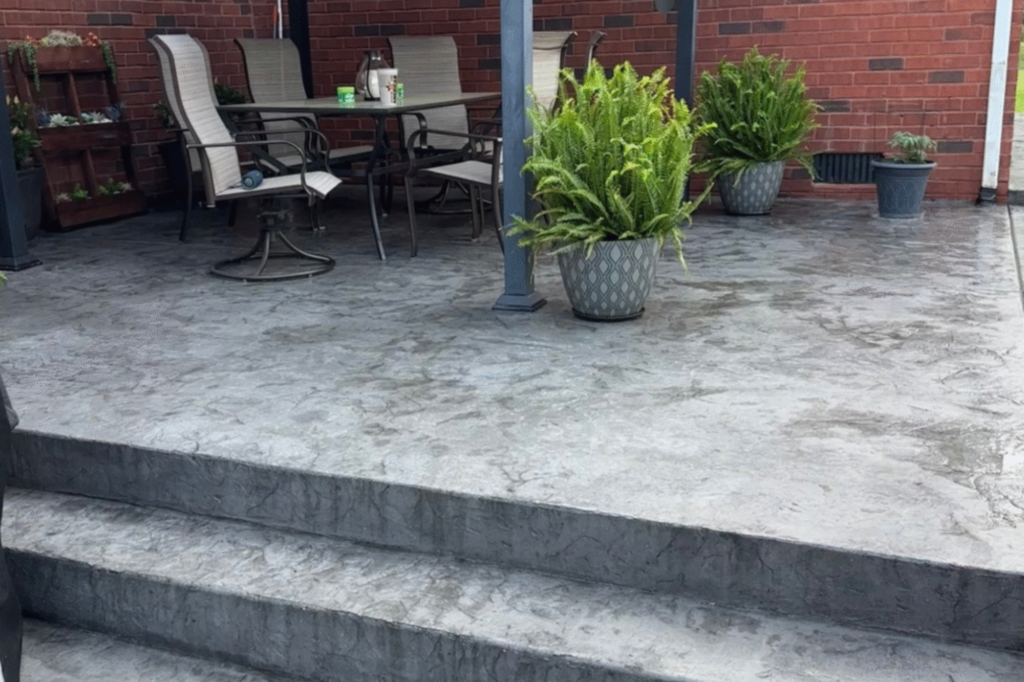
Applying a Structured Design Approach
To bridge the gap between standard solutions and tailored outcomes, a structured methodology can be applied. This approach moves away from one-size-fits-all execution and instead emphasizes context-specific design based on the unique characteristics of a space.
What is this approach?
It is a systematic framework that combines analysis of physical conditions with an understanding of how people interact within a space. It can be broken down into three core pillars:
Pillar 1: Alignment with Existing Structures
Design elements should correspond with the established lines and visual perspectives of surrounding structures. Rather than being arbitrarily placed, features are positioned to align with sightlines and primary access points, creating a cohesive, intentional visual flow.
Pillar 2: Integration with Natural Conditions
Instead of resisting environmental factors, this approach works with them. By identifying natural patterns, such as drainage, elevation changes, or other site dynamics, design decisions can enhance durability, stability, and long-term performance.
Pillar 3: Functional Zoning Based on Movement
Spaces are organized according to how people naturally move and interact within them. Distinct zones are defined for different activities, ensuring unobstructed circulation and an intuitive, efficient layout.
By applying this framework, the result is not just a constructed space, but a thoughtfully designed environment that responds to both the physical context and human behavior.
Finding the Right Partner in the Local Area
When searching for patio installers in Murfreesboro, it is important to look for those who have a vested interest in the long-term stability of the local landscape. The clay-heavy soil in many parts of the region requires specific excavation techniques that outside firms might overlook.
During a site visit, a qualified professional should be able to point out the specific challenges of your backyard layout within minutes. They should notice the way your neighbor’s runoff affects your property or how a particular tree’s root system might interfere with your dream seating area. This level of detail is what separates a true craftsman from a high-volume contractor.
In Summary
Finding the right professional, like Elite Concrete, for any project requires looking beyond surface-level appeal. A major investment’s success depends on how well the person or team understands the specific conditions and context involved. By prioritizing specialized expertise, thoughtful planning, and proven methodologies, you can ensure the final result is both aesthetically strong and structurally sound. Contact us today to get started.
People Also Ask
How do I know if my backyard is too sloped for a patio?
No slope is “too steep,” but it may require a tiered design or a retaining wall. A professional assessment will determine if a multi-level layout is necessary to create a functional flat surface.
What is the best material for a backyard with drainage issues?
Permeable pavers are often recommended for layouts with water concerns, as they allow moisture to filter through the joints and into the ground rather than running off the surface.
How long does it take to assess a backyard layout?
A thorough initial site survey usually takes between 45 and 90 minutes. This includes measuring elevations, checking for utility lines, and discussing your functional needs.
Should I have a design before I call an installer?
While not required, having a rough idea is helpful. However, a design-build specialist will typically create a professional CAD or 3D design as part of their service to ensure the layout is technically sound.